One system to run a restaurant group, with an AI that drafts and humans who approve
Pazza OS brings a restaurant's website, ordering, guest CRM, marketing, reservations, operations and reporting into one platform, with an AI layer that drafts the work and answers questions about the business.
 Pazza OS · Pazza Pizza (three Chicago locations)
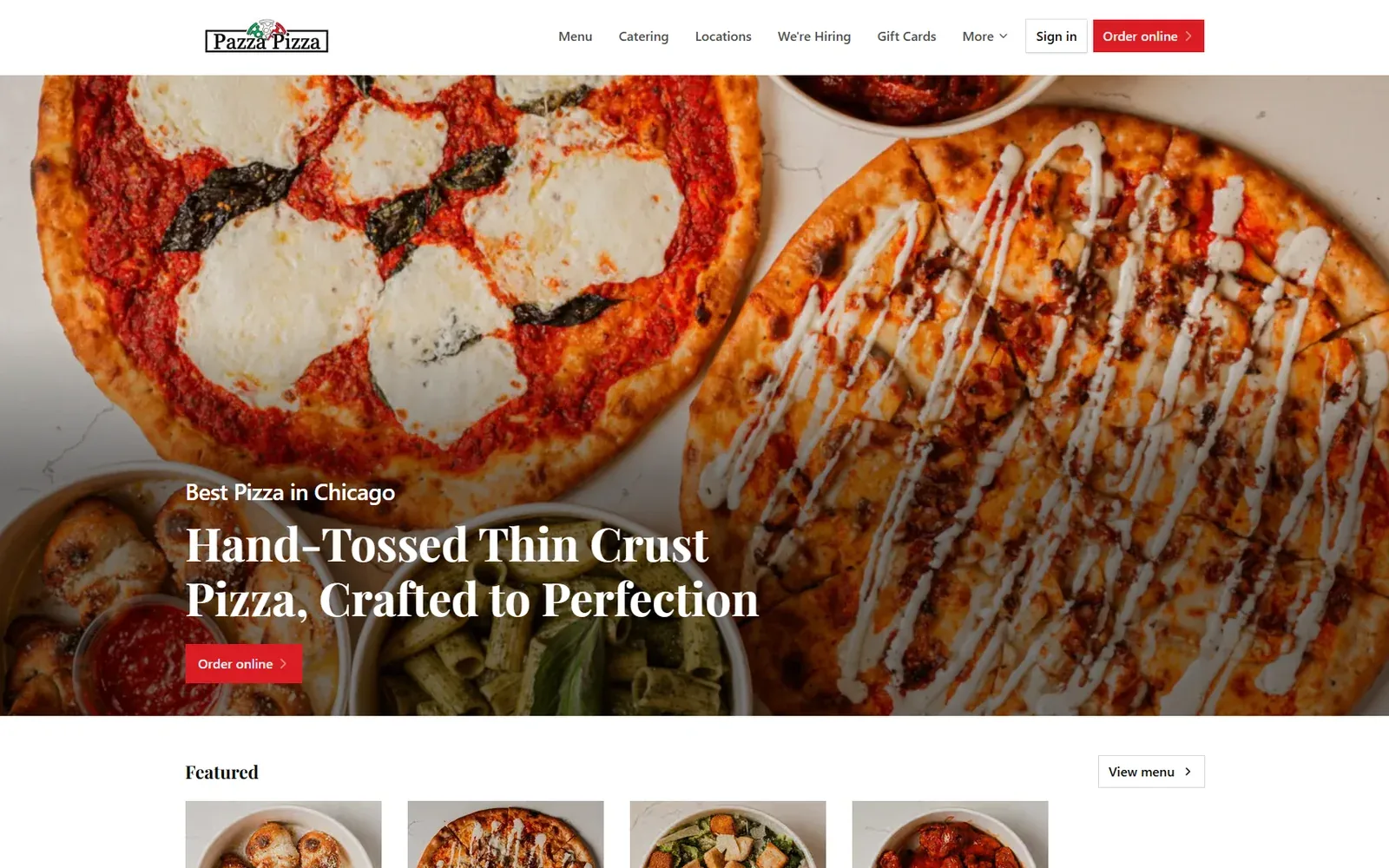
An independent restaurant group typically runs on half a dozen disconnected tools: one for the website and online ordering, a POS for the counter, another for email and SMS, separate consoles for Google and Meta ads, a spreadsheet for the marketing calendar, and something else again for inventory and labor. The guest who ordered online last Friday is invisible to the ads console, marketing results are guesswork, and the owner spends evenings reconciling systems instead of running the restaurants.
At a glance
| Client | Pazza Pizza, three locations in Chicago |
| Industry | Restaurants, multi-location food service |
| What we built | A restaurant operating system: branded website and online ordering, guest CRM and loyalty, email/SMS and marketing calendar, reservations and waitlist, gift cards, operations and inventory, and business intelligence, designed from day one to serve many restaurant groups |
| Where AI fits | A single AI gateway routes every Claude call. The assistant answers questions about the restaurant's own data and drafts campaigns, social posts and review replies, which land as drafts for a person to approve |
| Stack | Next.js web apps, Supabase/PostgreSQL with server-side functions, and a provider layer for POS, payment, delivery and messaging services |
| Status | A restaurant operating system built with Pazza Pizza |
The old way
- Orders come in through the website platform, third-party marketplaces and the POS, each with its own customer list.
- The marketing manager writes emails in one tool, schedules social posts in another and tracks it all in a spreadsheet calendar.
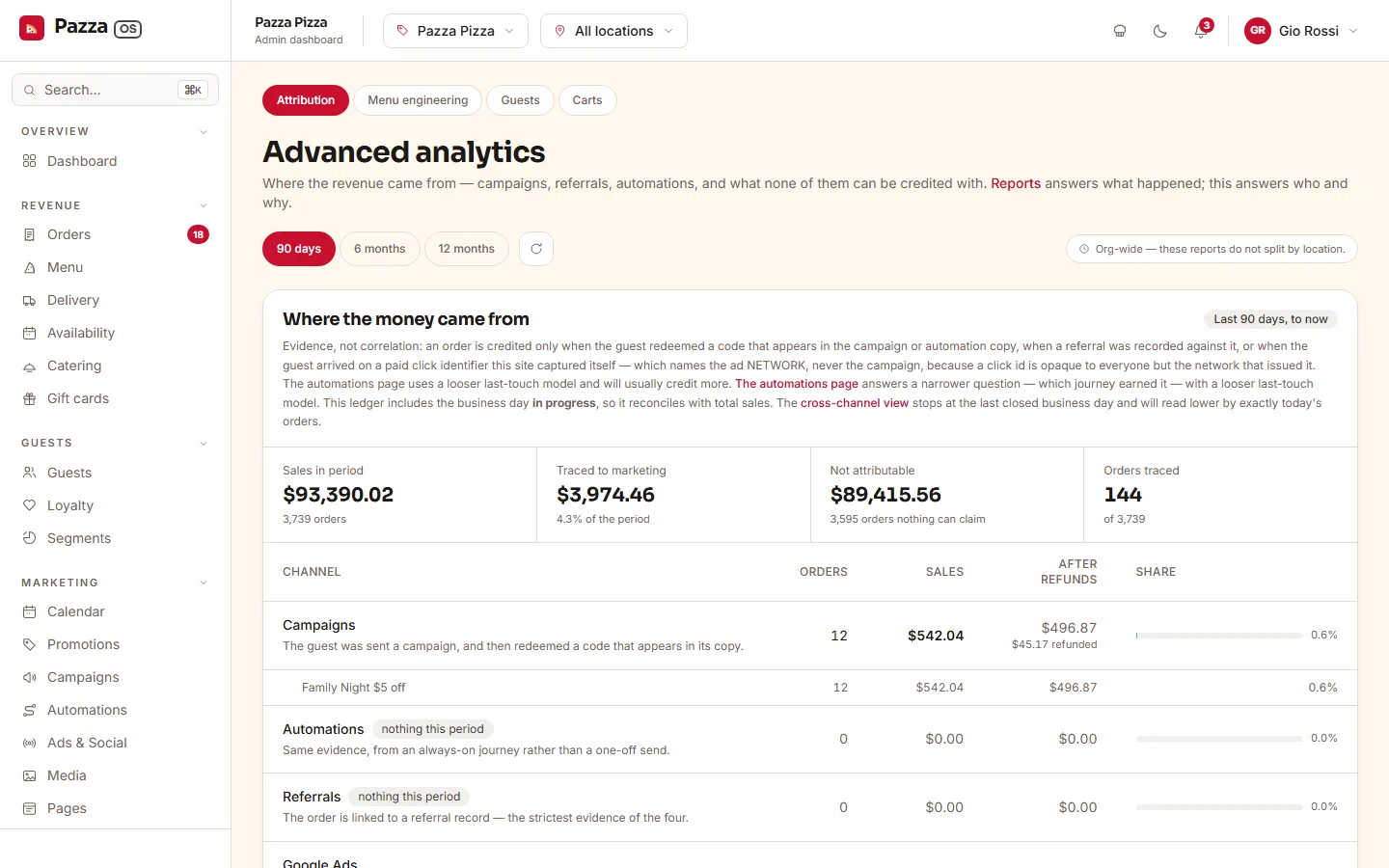
- Nobody can say which campaign brought in which orders.
- Managers check sales, labor and food cost by exporting reports from several systems.
- Questions like "how did the second location do last weekend compared with the week before?" take an evening of spreadsheet work.
What we built
One guest record, one calendar, one place to look.
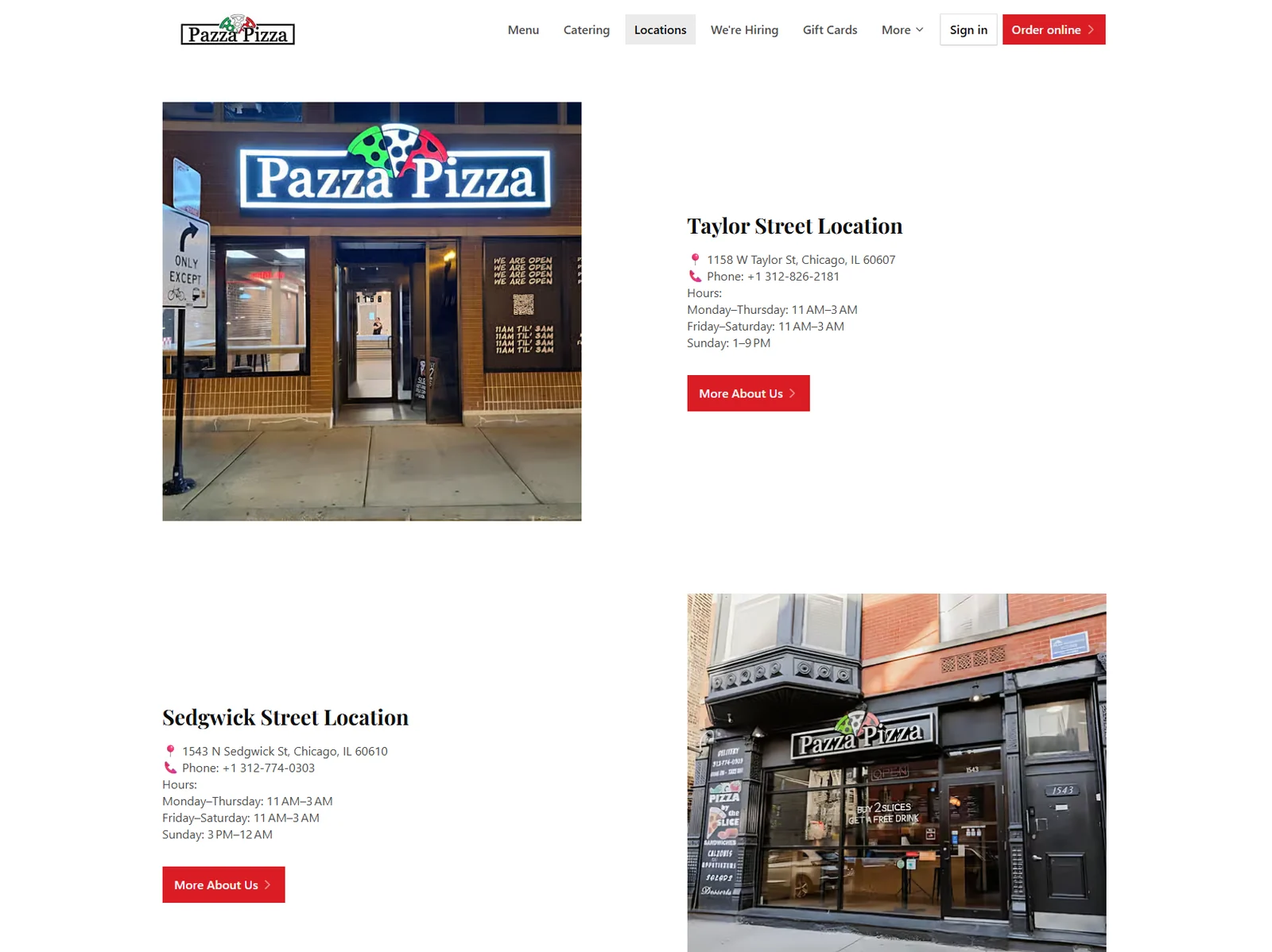
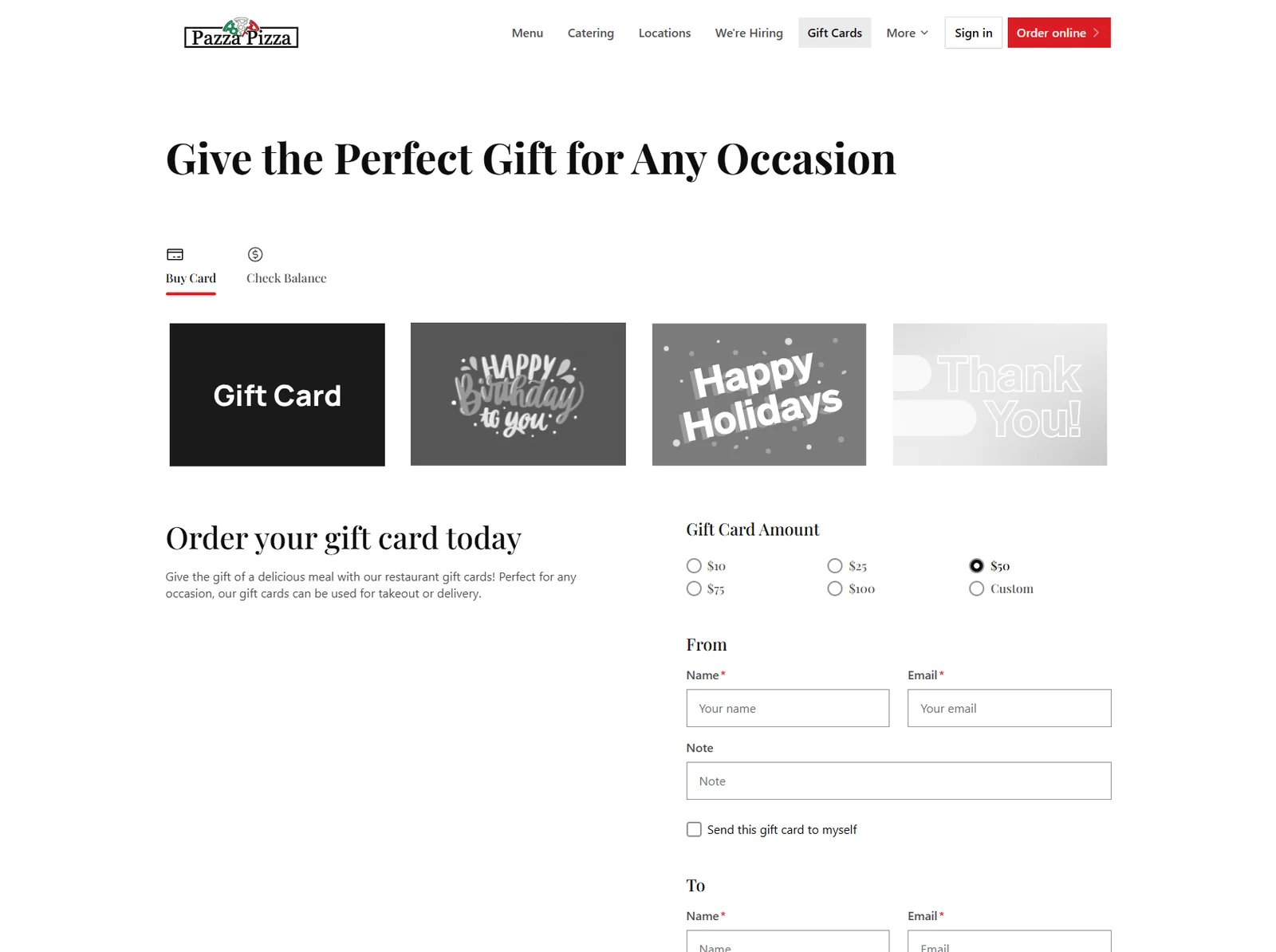
- Storefront and ordering. A fast, branded website with online ordering per location, catering inquiries, gift cards, hiring and a loyalty program. These are direct channels the restaurant owns, without marketplace fees.
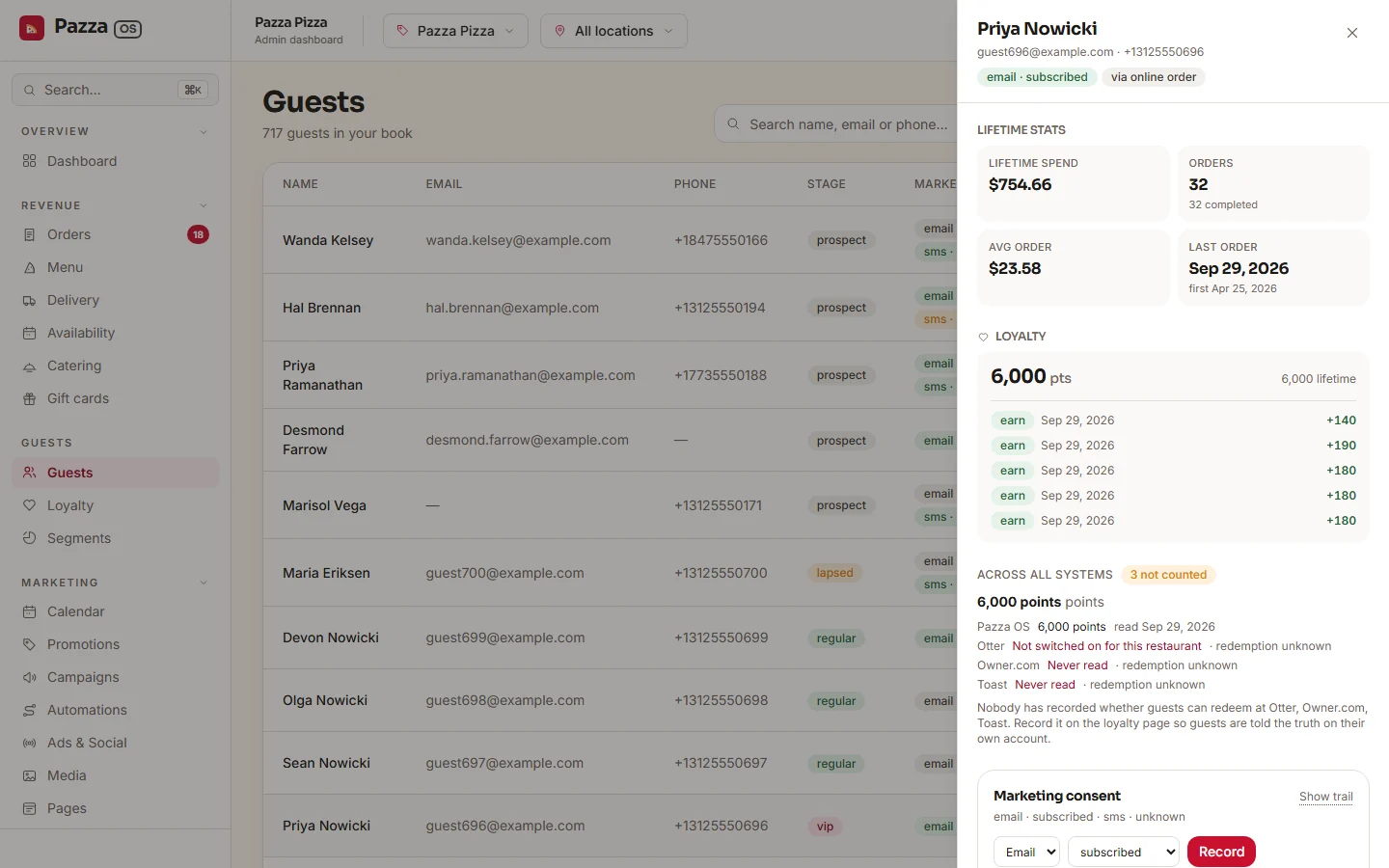
- Guest CRM and marketing. Every order, reservation and signup resolves to one guest record across locations. Email and SMS campaigns, the marketing calendar and reputation management all work from that same record, with consent tracked properly.
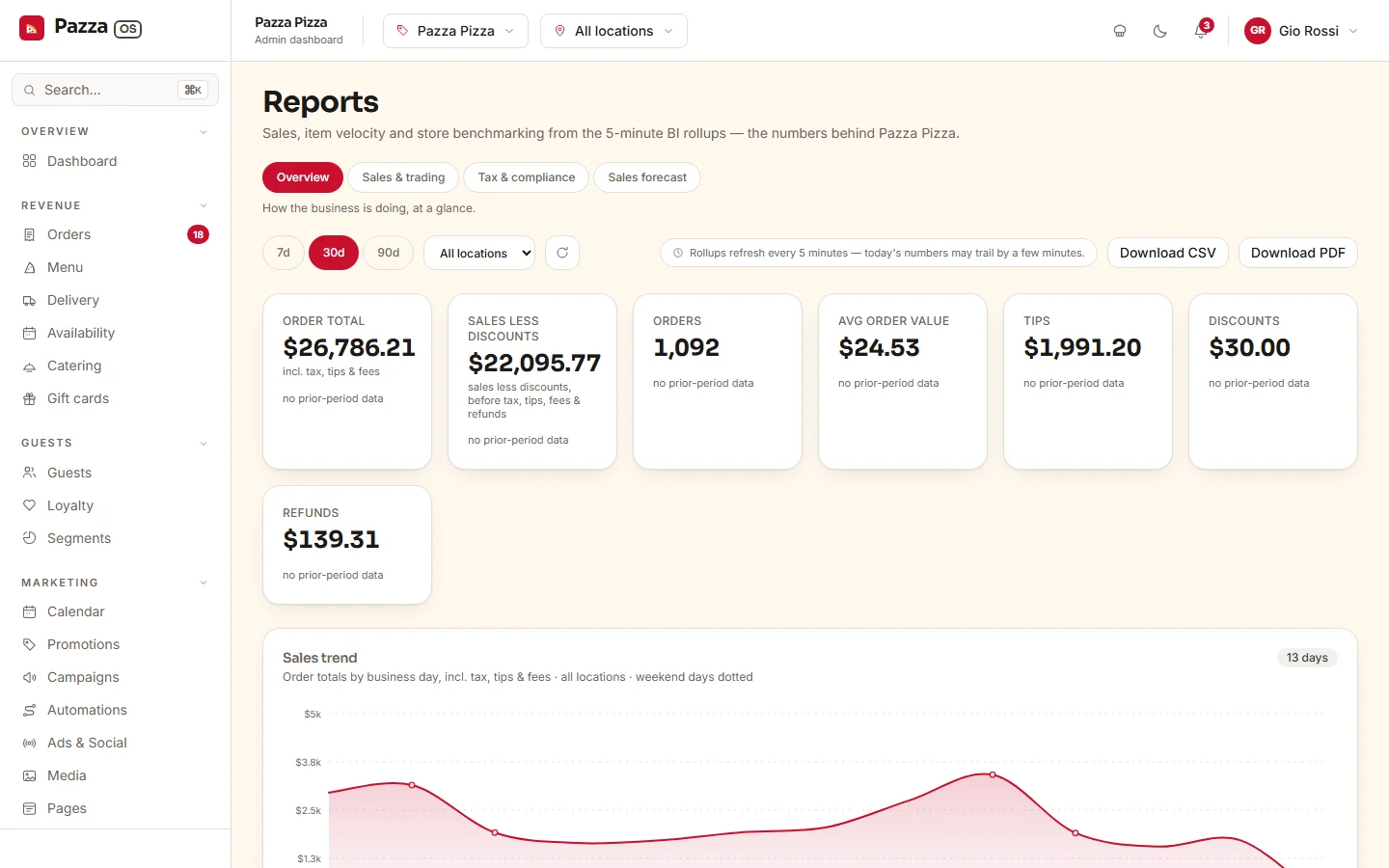
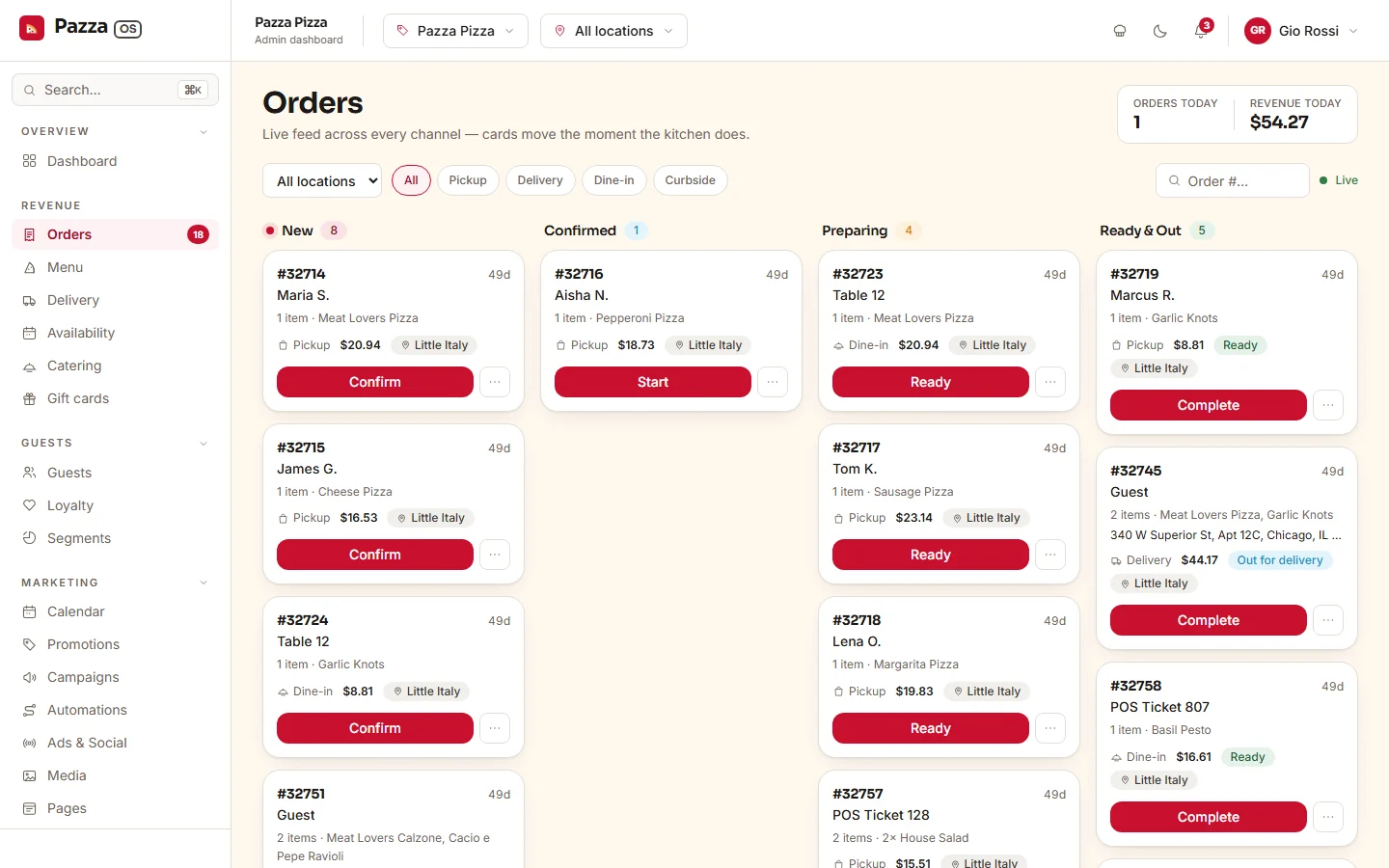
- Operations and reporting. Reservations, a floor view and waitlist, inventory and labor, plus daily sales dashboards across locations.
- Plugs into what's already there. The restaurant keeps its POS and delivery partners. Pazza OS connects to them through adapters rather than replacing them.
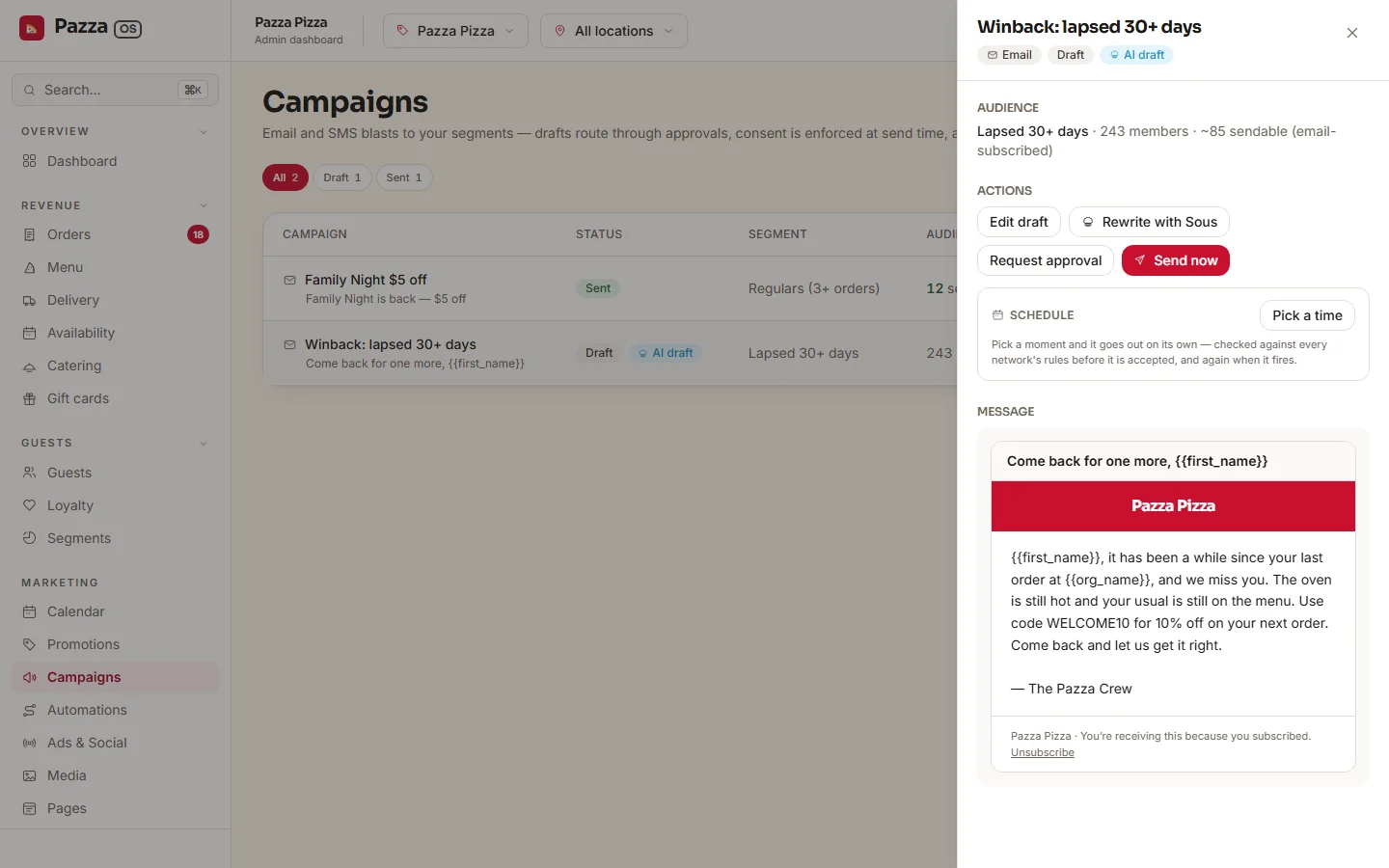
- AI as a layer, not a chatbot. The assistant answers questions over the restaurant's own data, and drafts marketing and operational content that flows into each module's normal approval step. AI proposes; people approve.
How the workflow changes
| Step | Before | With Pazza OS |
|---|---|---|
| Knowing your guests | Separate lists in each tool | One guest record across locations and channels |
| Planning marketing | A spreadsheet calendar plus several consoles | One marketing calendar; campaigns, posts and promotions scheduled in one place |
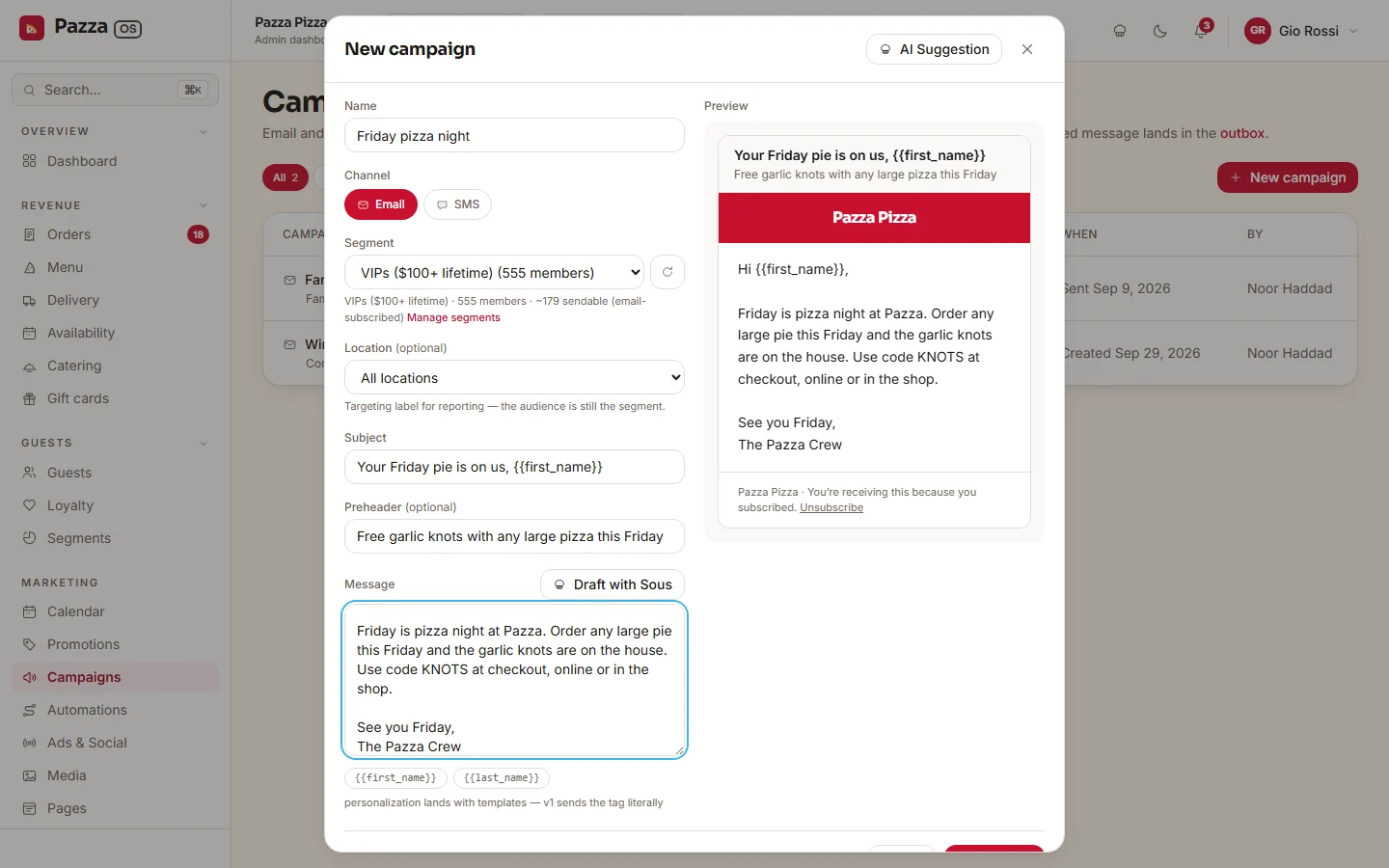
| Writing campaigns | Start from a blank page | Ask for "a win-back email for lapsed regulars" and get a draft, never sent without approval |
| Answering business questions | Export reports, build a spreadsheet | Ask in plain English and get numbers with the data they came from |
| Online orders | Marketplace fees on every order | Direct ordering on the restaurant's own site, per location |
| Managing a second or third location | Duplicate setups | Multi-location from day one: per-location menus, hours and channels under one account |
Inside the build
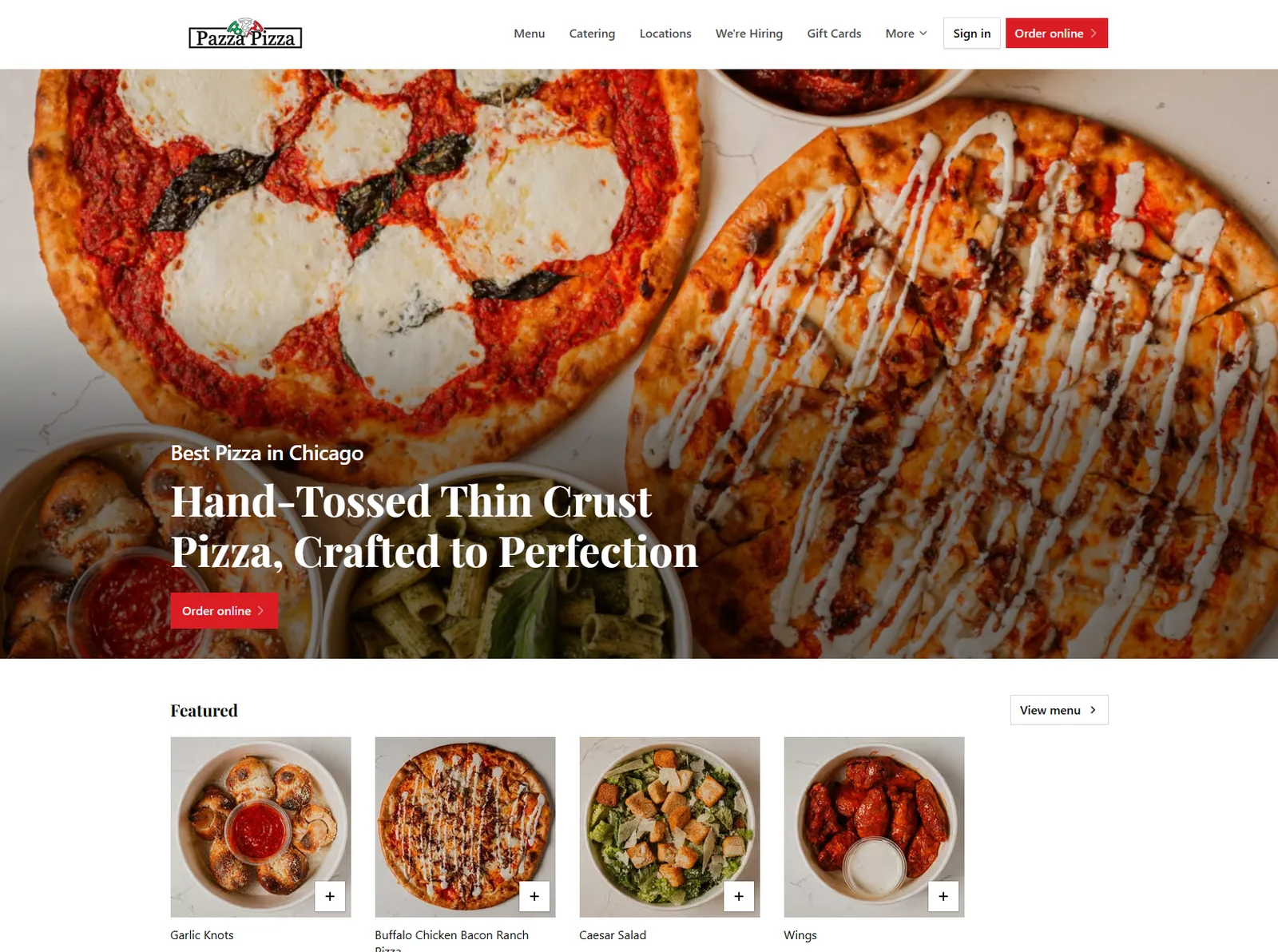
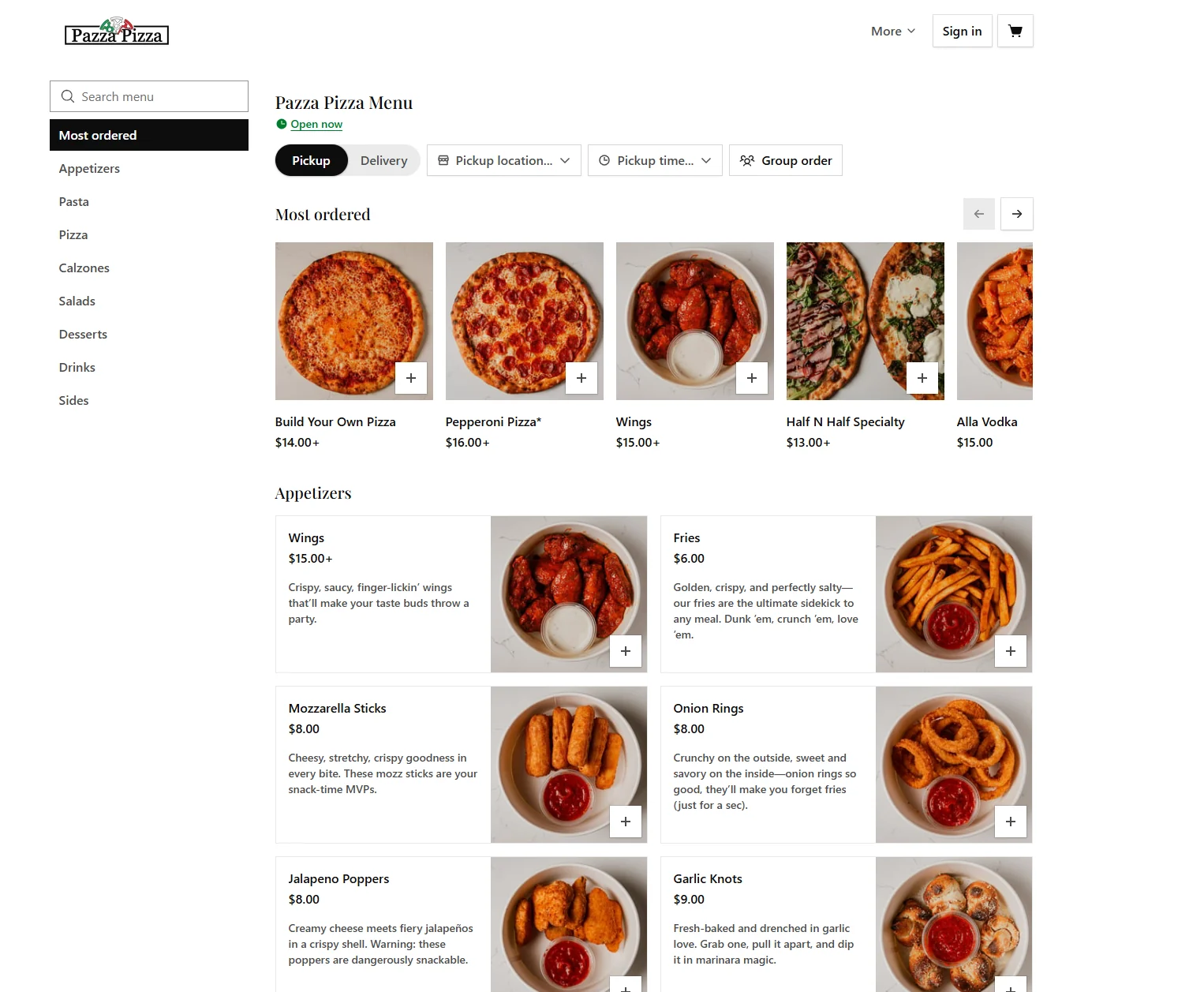
Behind the storefront is the operator's back office. These screens come from the local demo, with seeded guests and orders.
Under the hood
- One governed AI gateway. Every AI call, from every screen, goes through a single service that handles authentication, per-restaurant budgets and metering, model routing, output checks and logging. Costs can't run away, and every call is accounted for.
- Built for scale before it was needed. Database security rules were tuned on 20 million synthetic orders, taking a key query from about 1.7 seconds to under 0.1 seconds.
- Security reviewed by attack. An audit examined the system the way an outsider would, including every database function reachable without signing in, and the permission rules are pinned by automated tests.
- Integrations that are safe to retry. Payments, POS and delivery webhooks are processed exactly once, even when a provider sends them twice.
- Guard rails on the people building it. Tooling refuses to run production database commands unless the target is confirmed by name.
By the numbers
As of September 2026 Pazza OS carries over 370 database migrations, more than 300 database test files, about 2,400 unit tests and close to 500 browser tests. It connects to POS, payment, delivery and messaging providers through one provider layer, and it has been load-tested against 20 million synthetic orders.
Example scenario
Example scenario (illustrative): A two-location taqueria wants to stop paying marketplace commission on its regulars. They launch direct ordering on their own site, and every order now builds one guest list across both stores. On Monday the owner asks the assistant which regulars haven't ordered in sixty days. It answers with a count and the query behind it, then drafts a win-back email and a matching SMS. The marketing manager edits one line, approves both, and they appear on the shared calendar beside the weekend's social posts.
What this means for your business
Pazza OS is a vertical operating system with AI built in from the start. The pattern fits any business drowning in point tools:
- Restaurant groups and franchises that want direct ordering, one guest list and marketing they can measure.
- Multi-location service businesses (salons, clinics, studios) with the same fragmented-tools problem.
- Vertical SaaS companies that want a governed AI layer, with budgets, metering and approval flows, rather than a bolted-on chatbot.
Second Voyage builds AI systems that are held to a standard you can check. Talk to us about yours.