

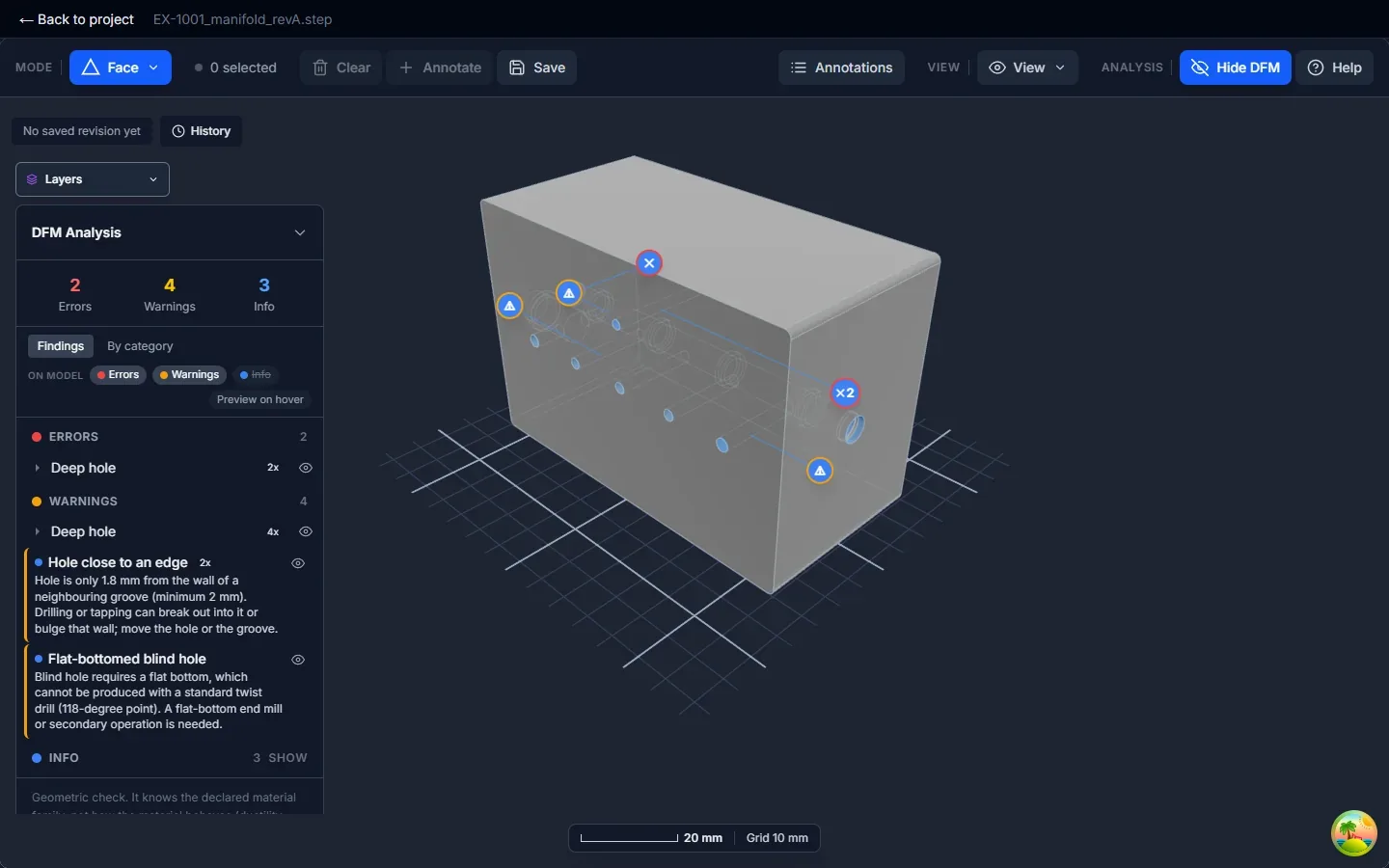
At most machine shops, quoting still runs on email. A customer sends a STEP file and a PDF drawing. Someone downloads them, opens CAD, eyeballs the part for features that will be expensive or impossible to machine, works up a price in a spreadsheet, and replies days later. If the design has a problem, such as a pocket too deep for any standard tool or a hole that can't be reached, the customer finds out in a phone call, and the whole loop starts again.
Cadence Forge is a quoting portal we built for machine shops and fabricators. Customers upload CAD and see what's hard to make on the part itself, and the shop handles quotes, orders and invoices in one place, connected to its accounting and its shop floor.
At a glance
| Client | Precision machine shops and fabricators that quote from CAD |
| Industry | Precision CNC machining and sheet metal |
| What we built | A customer quoting portal: CAD upload, automatic design-for-manufacturability (DFM) findings on a 3D model, quotes, revisions, orders and invoices, with a staff back office connected to accounting and the shop floor |
| Where AI fits | AI-assisted engineering built most of it, under strict regression gates. In the product, a small AI help assistant answers staff "where is…" and "how do I…" questions from the help pages only. No customer, part or price data is ever sent to it |
| Status | A customer quoting portal for machine shops |
The old way
- A customer emails a STEP file and a drawing.
- Someone downloads them and opens the part in CAD software.
- An estimator inspects the geometry by eye for costly or unmachinable features.
- Pricing happens in a spreadsheet, using rules of thumb that live in a few people's heads.
- The quote goes back by email. Revisions, purchase orders and invoices each start their own thread.
- Design problems surface late, often after the order is placed.
What we built
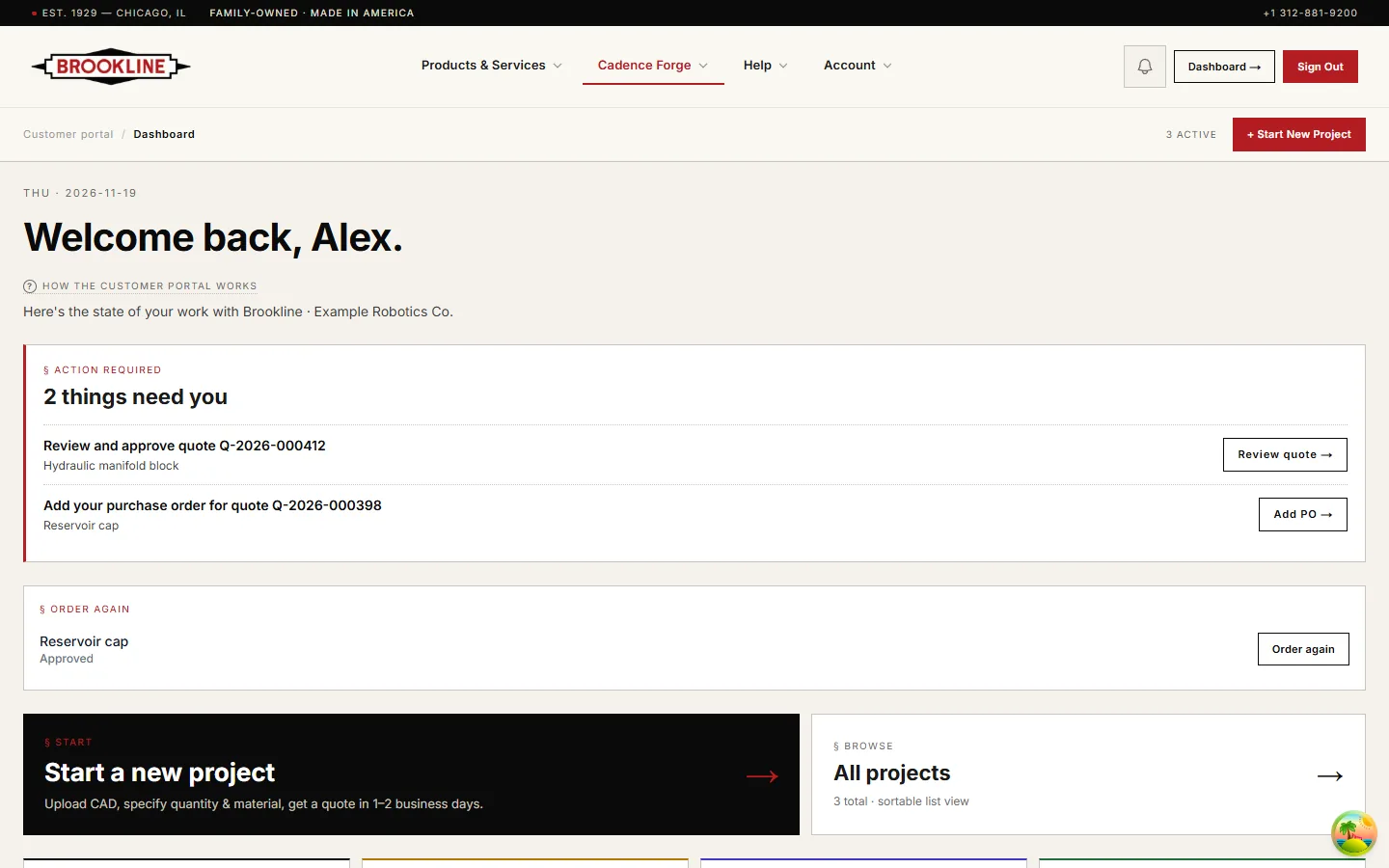
- A customer portal. Customers upload CAD, see their part in 3D with design-for-manufacturability findings highlighted on the model (what's hard to make, where and why), and review and accept quotes, follow orders and see invoices in one account. The shop's staff own the final call on every finding.
- A geometry engine that reads the part. Cadence Forge's own engine reads STEP files, recognizes machining features (holes, pockets, slots and more), reads the drawing's tolerances when the CAD carries them, and runs a library of DFM rules. For sheet metal it unfolds the part, works out bend allowances and a bend sequence, and estimates how parts nest on a sheet for pricing.
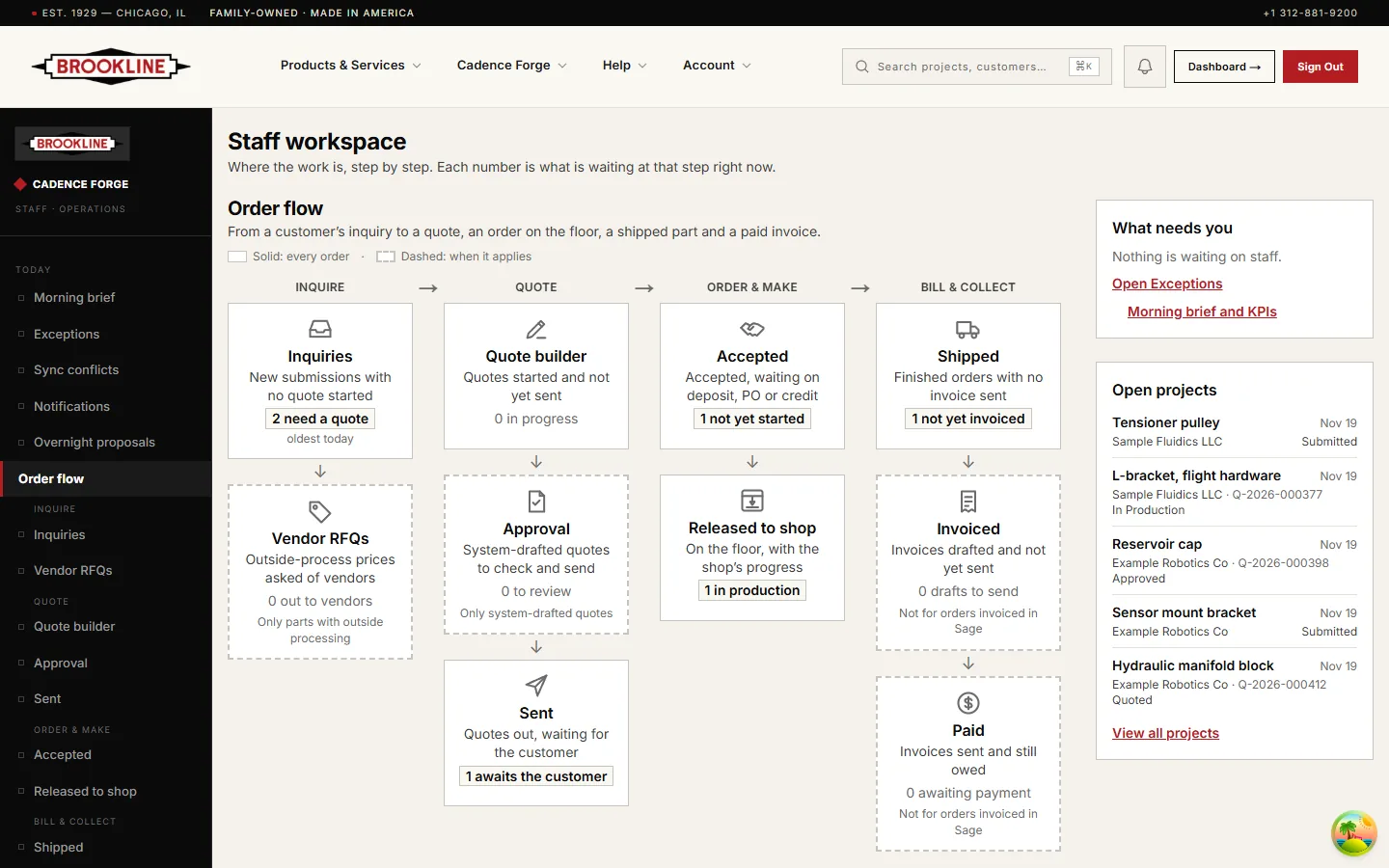
- A staff back office. Staff review the analysis, price, send, revise and invoice. A morning brief lists every exception, and reports cover quote win rate and quoted-versus-actual cost.
- Connected to the books. Invoices post to Sage 50 automatically, each entry exactly once, even when a posting is retried.
- Connected to the shop floor. Accepted work flows to the shop's floor system, such as the shop-floor system we built for Brookline Industries, and job progress flows back.
How the workflow changes
| Step | Before | With Cadence Forge |
|---|---|---|
| Receiving a request | An email with attachments | An upload into the customer's account, tied to their history |
| Finding design problems | An estimator's eyes, sometimes after the order | Automatic DFM findings on the 3D model, visible before the customer commits |
| Pricing | A spreadsheet and rules of thumb | Staff price with the part's analyzed features, and a sheet-nesting estimate, in front of them |
| Revisions | A new email thread each time | Versioned quotes in one place |
| Order to invoice | Re-keyed into accounting | Posted to Sage 50 automatically, exactly once |
| Knowing how quoting performs | Unknown | Win-rate and quoted-versus-actual reports, plus a morning exceptions brief |
Inside the build
Every screenshot here shows demo data, not customer data. Names, addresses, figures and documents are made up for illustration.
Under the hood
- Human-approved geometry baselines. Every change to the geometry engine is checked against approved results for a library of test parts. If a part's analysis changes, a person must approve the new answer before it becomes the baseline, which catches silent misclassification.
- Money logic that never guesses. Charges, cancellations and totals treat unknown values as unknown, never as zero, so a missing input can't quietly produce a wrong invoice.
- An AI helper with hard limits. The staff help assistant can only read help pages and the app's own navigation, and its use is capped.
- Built by AI, held to tests. The large majority of commits were written with AI assistance, behind thousands of automated tests across the web app and the engine.
By the numbers
At the time of writing we counted roughly 139,000 lines of application code and more than 3,500 automated test cases in Cadence Forge, plus about 1,390 test cases in its geometry engine.
Example scenario
Example scenario (illustrative): A product designer at an equipment maker uploads a bracket on Tuesday morning. Before requesting a price, they see two findings on the 3D model: an internal corner too sharp for any standard end mill, and a hole too deep for its diameter. They adjust both in CAD and re-upload. The shop's estimator opens the request already knowing the features, prices it the same day, and the accepted quote becomes an order the shop floor can see, with no email thread and no re-keying.
What this means for your business
This is the front door of a manufacturing business, rebuilt so customers get answers before they have to ask. We build this kind of system for:
- Job shops, fabricators and contract manufacturers that quote from CAD.
- Industrial distributors with configurable or made-to-order products.
- Any B2B business that quotes from technical files (drawings, specs, schematics) and loses days to email back-and-forth.
Second Voyage builds AI systems that are held to a standard you can check. about yours.