

When a building inspector cites a crumbling porch, a restaurant fails a pest inspection, or a basement floods badly enough for someone to call 311, the city writes it down, and much of that record is published as open data. Each entry means a property owner or business needs help, often on a deadline. Most contractors never see these signals. They pay for shared leads that five competitors also bought, or they wait for the phone to ring.
For Chicago Loop Remodeling we built a lead engine that reads those public records every day, matches them to real properties, scores how urgent each one is, and hands contractors exclusive leads with the evidence attached. Any outreach it drafts may only state facts from the public record, and is checked before it can go out.
At a glance
| Client | Chicago Loop Remodeling, a Chicago remodeling and property-services company |
| Industry | Home and commercial services: plumbing, porch and masonry, pest control, roofing, HVAC, restoration and more |
| What we built | A daily data pipeline, a lead-scoring model, a compliance policy engine, fact-checked AI drafting for outreach, and a contractor inbox |
| Where AI fits | Classifying free-text inspection comments, scoring how urgent and how likely to stay unresolved each issue is, and drafting outreach that may only state verified facts |
| Status | A public-records lead engine for contractors, with fact-checked AI outreach |
The old way
- A contractor buys leads from a marketplace, and the same lead goes to several competitors.
- They don't know why the customer needs work, or how urgently.
- Public records that would tell them (violations, failed inspections, 311 complaints, storm reports) sit in dozens of separate city and county datasets.
- Even when someone finds a good signal, matching it to the right property and a reachable contact takes manual research.
- Outreach is ad hoc, and staying compliant with email and calling rules is left to the contractor to figure out.
What we built
The lead engine watches six kinds of public signal: violations, inspections, permits, 311 complaints, property records and storms.
Detect. Every day, it collects Chicago and Cook County datasets: building violations, failed food inspections, 311 service requests, permits, administrative hearings, property records and sales, and NOAA storm reports.
Resolve. Each record is matched to a Cook County property, so five records about one building become one picture of that building.
Classify and score. Violation codes map to a service trade (a porch code goes to carpentry, a food-inspection pest finding goes to pest control). An AI model reads the free-text inspector comments that codes miss. A machine-learning model estimates how likely each issue is to still be open in 30, 60 and 90 days, and an urgency score weighs deadlines, hearing dates, season and building age.
Reach out, within the rules. Every outbound message is drafted by AI from a fact sheet of verified public facts only, then checked against the facts and the compliance rules before anything is sent. Anything that fails is held for a person to review.
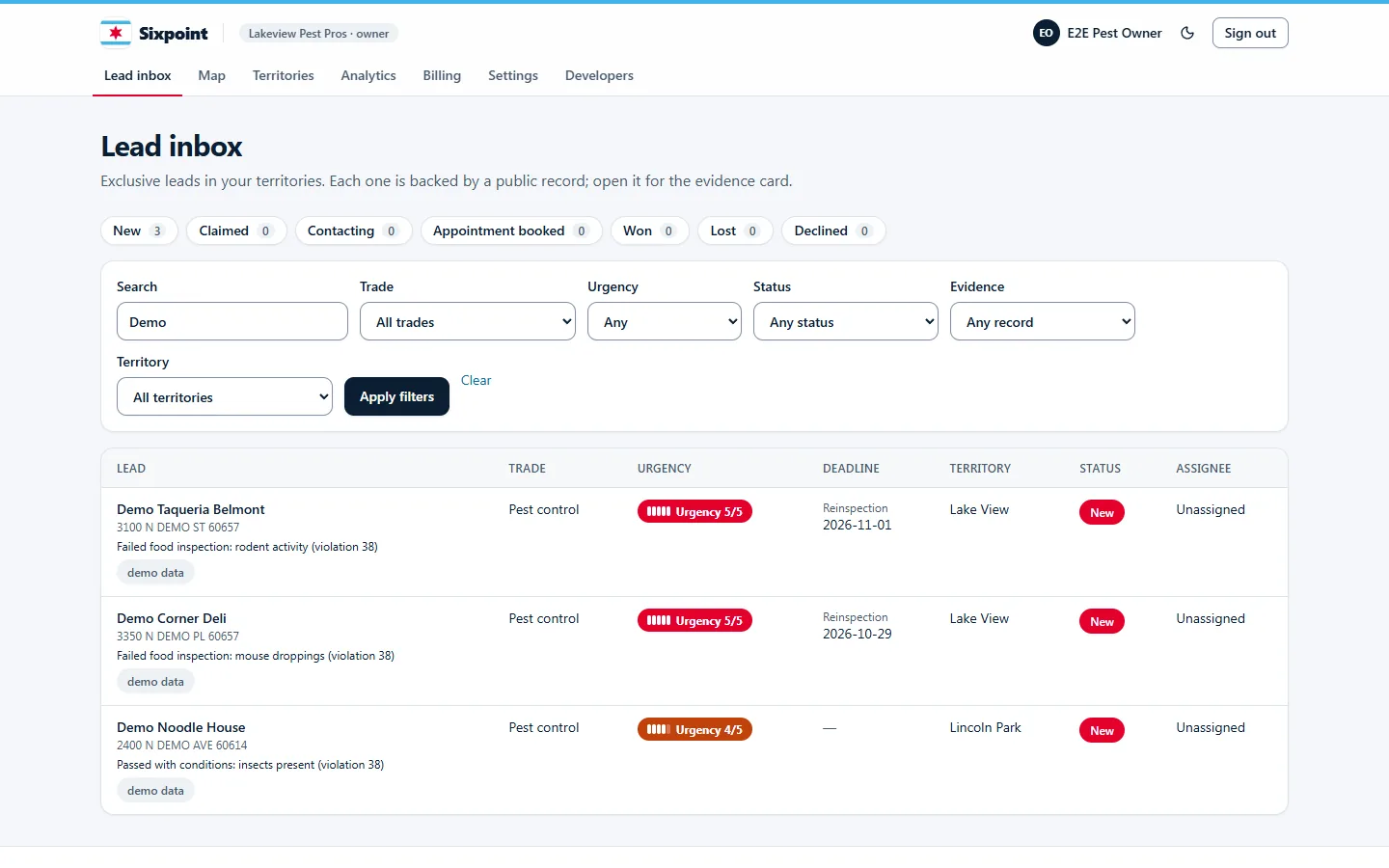
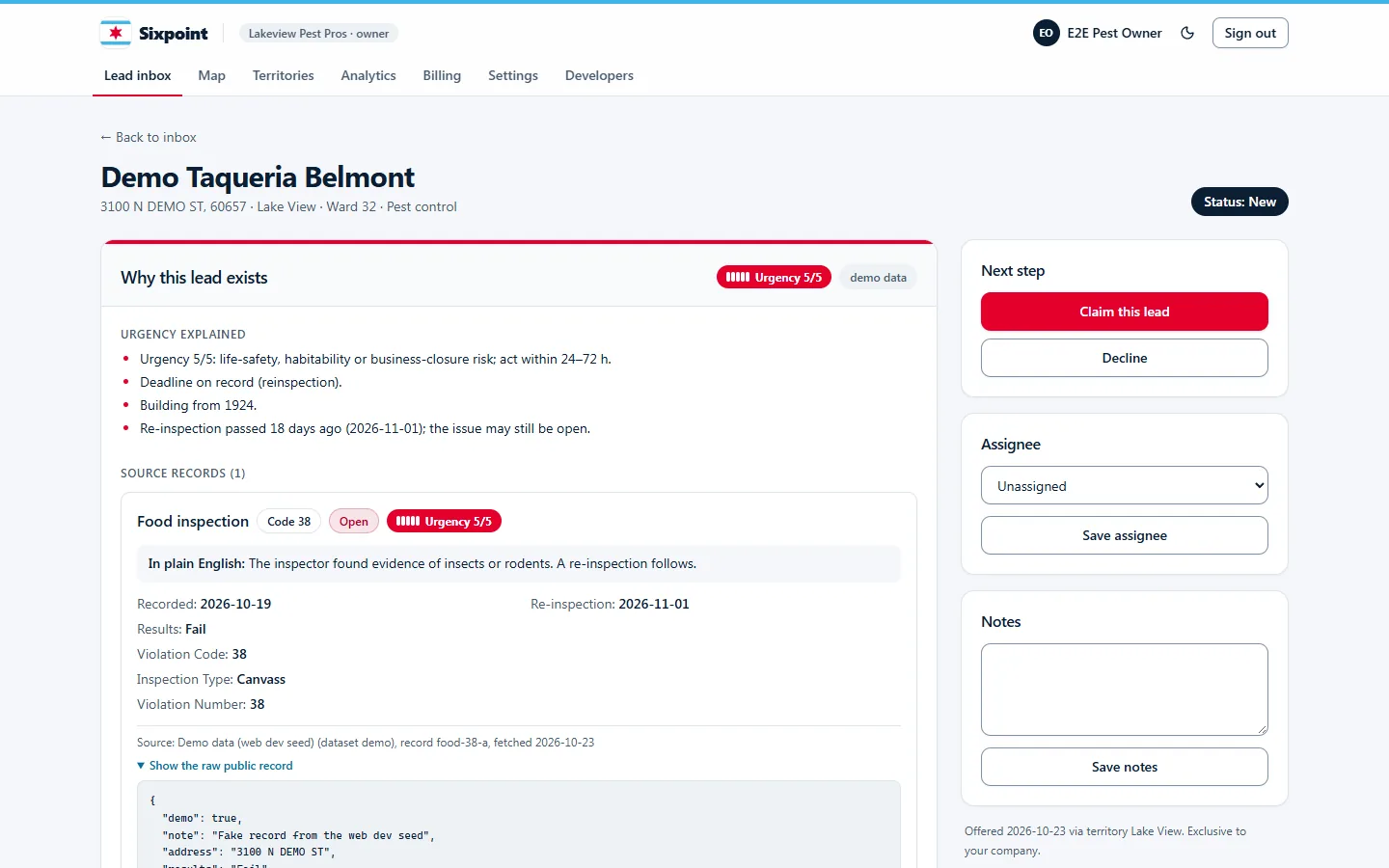
Deliver. Each lead goes to one contractor per trade per territory, with an evidence card showing the public record behind it.
How the workflow changes
| Step | Before | With the lead engine |
|---|---|---|
| Finding work | Buy shared leads; wait for calls | A daily feed of new, exclusive leads in your trade and area |
| Knowing why | "Homeowner requested a quote" | The evidence card: the citation, the date and the deadline |
| Prioritizing | First come, first served | Ranked by urgency and by how likely the issue is to stay unresolved |
| Writing outreach | A generic template, or nothing | A draft that may only state facts from the record, checked before it can go out |
| Staying compliant | The contractor's problem | A policy engine that blocks or holds anything that breaks a rule, and records why |
Inside the build
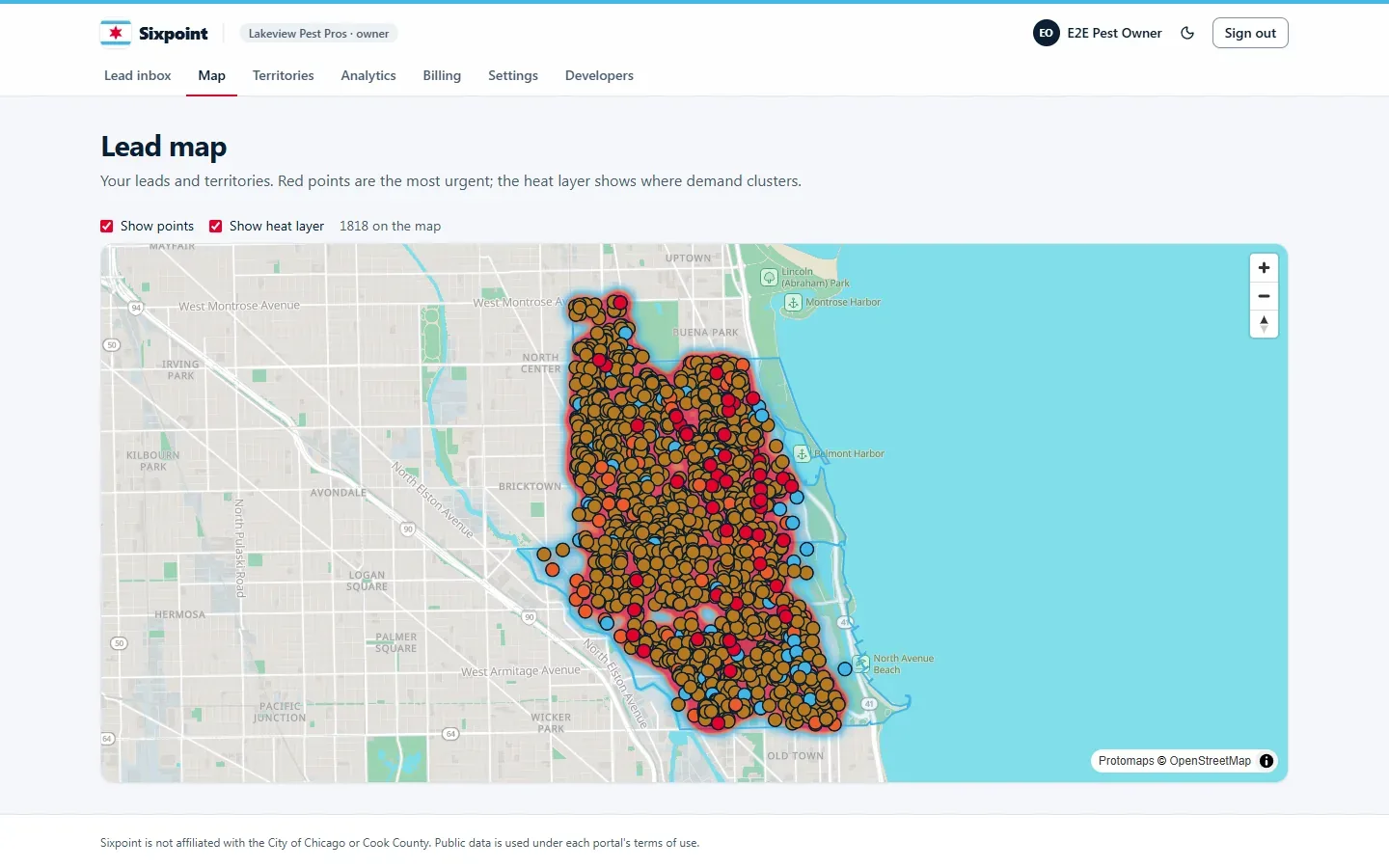
These screenshots use demo businesses and test accounts, not customer data. The map's points are real public Chicago and Cook County records, shown without labels.
Under the hood
- A fact-checker that isn't another AI. Before a drafted message can go out, a rule-based checker pulls every checkable detail from it (dates, amounts, addresses, phone numbers) and requires each one to match the lead's verified fact sheet. Anything it can't trace holds the message for review.
- Checks before every send. Each message must pass compliance, duplicate, fact and rate checks before it leaves, and if the audit record can't be written, nothing goes out. Every block is recorded with its reason.
- Compliance as code. A policy engine with 25 named rules covers opt-outs, do-not-contact lists, consent requirements for automated calls and texts, and Illinois-specific rules. Each rule cites its source, and an operator can see exactly why a message was stopped. Automated calls and texts go only to people who have given consent.
- Safe by default. Sending stays in a test mode until an operator switches it on, and paid data sources sit behind a separate switch.
By the numbers
- About 1.2 million signals and 347,000 open leads loaded from Chicago and Cook County data (per the project's own load).
- More than 700 automated tests.
- 25 named compliance rules.
The scoring model has been tested on held-out data from a later period than the data it learned from. For predicting whether a building violation is still open after 30 days, it ranks cases better than a simple baseline that uses each violation type's historical rate: an AUC of 0.869 against 0.788. AUC measures how well a model puts the cases that matter ahead of the ones that don't, where 0.5 is a coin toss and 1.0 is perfect. The project also runs a fairness review of the model across neighborhoods.
For Chicago Loop Remodeling, we also rebuilt the brand and launched a search-optimized site. Chicago Loop Remodeling reports an estimated $78K in new revenue, three large jobs within four weeks of launch and five warm inbound leads a week, with no ad spend.
Example scenario
Example scenario (illustrative): A two-truck pest control company signs up for restaurants on Chicago's North Side. On Monday, three restaurants in its territory fail inspections for pest findings. By Tuesday morning the owner sees all three in the lead inbox, each with the inspection date and finding. The restaurant whose re-inspection is soonest is ranked first. The outreach draft names only the facts on the public record, and the company follows up the same day.
What this means for your business
The pattern is public signal → resolved entity → scored opportunity → fact-checked action, and it works far beyond home services.
- Insurers and restoration firms: storm and claim signals turned into prioritized outreach.
- Commercial cleaning, pest control and food-safety vendors: inspection outcomes as a pipeline.
- Property services and lenders: monitoring a portfolio against public violation and permit records.
- Any team sending AI-drafted messages that must never state something untrue: the fact-checker and the send checks are reusable on their own.
Second Voyage builds AI systems that are held to a standard you can check. about yours.